Cool comfort, back fast.
Air conditioning repair in Baton Rouge means getting a struggling or dead cooling system back online during the months when indoor temperatures climb fast. When you search for air conditioning repair Baton Rouge because a unit is blowing warm or tripping the breaker, you want a straight diagnosis and a real ballpark before any work starts. This page lays out what gets fixed, what it tends to cost, and how to decide between a repair and a replacement.
📞 Call (225) 529-7586
Text or call about your air conditioning repair job — a quick photo helps us quote fast.
A firm, all-in price confirmed before we start — no surprises.
On time, done to standard, and tidy when we leave.

A no-cool call usually traces to one of a handful of failures: a tripped breaker, a failed capacitor, a frozen evaporator coil, a low refrigerant charge, a bad contactor, or a blower or condenser motor that quit. Baton Rouge summers push equipment hard, and the humidity here means a system that stops running can let indoor moisture and temperature climb fast. A technician confirms the actual cause on-site rather than guessing, then quotes the repair before touching anything.
Emergency no-cool service fits when the house has no usable cooling and waiting is not comfortable or safe — for example, homes in Mid City and Spanish Town with older bungalows that heat up quickly, or families in Sherwood Forest, Villa del Rey, and Shenandoah with young children or elderly members. If the system is still cooling somewhat and the issue is minor, a scheduled non-emergency visit is often the cheaper path; the trade-off is a longer wait. Emergency response prioritizes speed, so it is the right call when the AC is fully down during a Louisiana heat spell.
Access and layout affect the visit. Garden District and Southdowns homes often have attic air handlers that take longer to reach, while many Broadmoor and Goodwood properties have exterior condensers along the side yard that are quicker to service. In Villa del Rey and University Gardens, older condensing units sometimes need a capacitor or contactor rather than a full replacement, which is a faster and lower-cost fix. Knowing the neighborhood and equipment age helps set realistic expectations before the technician arrives.
Refrigerant-related no-cool issues deserve a note: a system that lost its charge has a leak somewhere, and simply adding refrigerant without addressing the leak is a temporary measure. A technician will explain whether a repair holds long term or whether the underlying leak needs attention. For no-cool calls across East Baton Rouge Parish, the goal is honest diagnosis first, then a fix that lasts through the season.
| Emergency diagnostic / service call | $90-$180 ballpark, exact confirmed on-site |
| Capacitor replacement | $150-$400 ballpark |
| Contactor replacement | $150-$350 ballpark |
| Blower or condenser fan motor | $300-$700 ballpark |
| Refrigerant leak diagnosis and recharge | $300-$900+ ballpark, depends on leak and charge |
Same-day response is typical for no-cool emergencies in Baton Rouge during cooling season. Homes with no working AC are prioritized, and call volume during heat waves can affect timing, so calling early in the day helps.
Warm air from an AC in Mid City usually signals a real fault such as a low refrigerant charge, a frozen coil, or a failed capacitor. If the home has no cooling and the temperature is climbing, it qualifies as a no-cool emergency and warrants a same-day visit.
A no-cool emergency AC repair in Baton Rouge starts with a diagnostic fee, then the repair is quoted before work begins. Common fixes like a capacitor or contactor fall in the lower ranges, while motor or refrigerant-leak repairs cost more; the exact price is confirmed on-site.

A refrigerant leak shows up in ways homeowners across Mid City and the Garden District notice fast: weak cooling on the hottest afternoons, ice forming on the copper line at the outdoor unit, or a hissing sound near the indoor coil. Because Baton Rouge summers push condensers hard from May through September, a small leak that a system tolerated in spring often becomes a comfort problem by July. Repair starts with pressurizing the system and pinpointing the exact leak — usually at a coil, a service valve, a Schrader port, or a brazed line joint — before any refrigerant is added.
The repair decision hinges on where the leak sits and how old the equipment is. A leak at an accessible line set or valve in a Southdowns or Spanish Town home is a straightforward seal-and-recharge. A leak inside an aging evaporator coil is a bigger call: repairing the coil versus replacing it often costs close enough that the age of the whole system matters. Systems still using R-22 raise the stakes further, since that refrigerant is no longer produced and each pound is expensive — for older R-22 units in neighborhoods like Sherwood Forest and Villa del Rey, a large coil leak is frequently the moment to weigh a full system replacement against another patch.
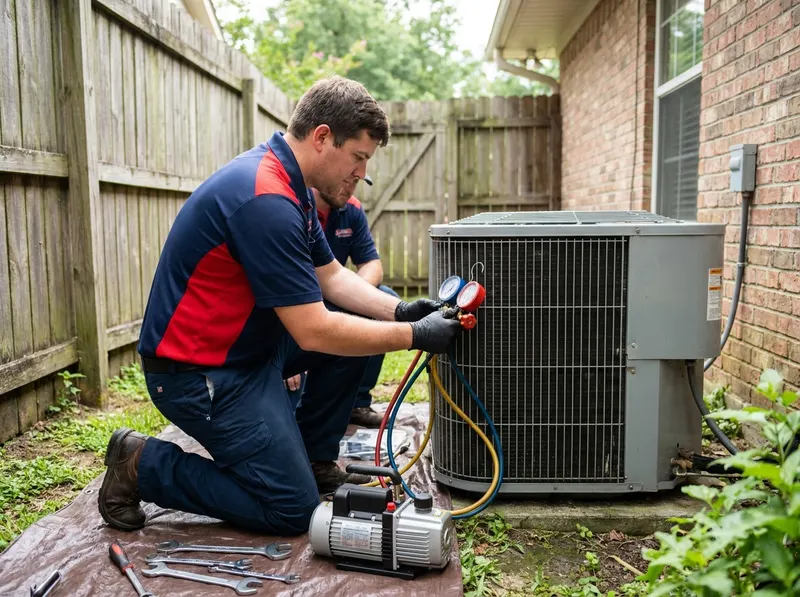
Proper recharge is what separates a lasting fix from a repeat call. After the leak is sealed, the system is evacuated with a vacuum pump to remove air and moisture, then charged by weight or by superheat and subcooling readings — not by guessing. Overcharging or undercharging a Broadmoor or Shenandoah home's system reduces efficiency and shortens compressor life, so measured charging is the standard. If a technician tops off refrigerant without finding the leak, expect the same problem within a season, which is why leak location comes first.
Humidity is the quiet factor in Baton Rouge. When a system is low on refrigerant, it not only cools poorly but also stops removing moisture well, leaving homes in Goodwood and University Gardens feeling clammy even when the thermostat reads a reasonable number. Restoring the correct charge brings back both temperature control and dehumidification, which is often the difference customers feel most.
| Leak detection (electronic/dye) with diagnosis | $120 - $300 |
| Line-set or valve/Schrader leak repair with recharge | $300 - $700 |
| Evaporator coil leak repair or replacement | $600 - $2,000+ |
| Refrigerant recharge (R-410A, per system) | $250 - $600 |
| Refrigerant recharge (R-22, per system) | $400 - $900+ |
Common signs of a refrigerant leak in Baton Rouge include weak cooling during peak heat, ice on the copper line or coil, longer run times, and higher humidity indoors. A technician confirms it with a pressure and leak-detection test before recommending repair.
Adding refrigerant without repairing the leak is not a fix and is discouraged in Baton Rouge because EPA rules address venting refrigerant. The leak will keep losing charge, so we locate and seal it first, then recharge to the correct level.
For older R-22 systems in Baton Rouge neighborhoods like Sherwood Forest and Villa del Rey, refrigerant is costly and no longer manufactured, so a large coil leak often makes replacement worth comparing. We give both the repair estimate and the replacement option so you can decide.

A capacitor is the round metal cylinder inside the condenser cabinet that stores and releases the electrical charge motors need to start and keep running. In Baton Rouge's long cooling season, capacitors fail from heat stress and constant cycling, and the swelling top or leaking oil is often visible the moment the panel comes off. The classic sign is a unit that hums but won't spin, or a fan you can nudge into motion with a stick. That symptom points to a capacitor far more often than a compressor, which is why testing the capacitor first saves Southdowns and Garden District homeowners from paying for a repair they don't need.
A contactor is the electrical switch that closes to send power to the compressor and outdoor fan every time the thermostat calls for cooling. Contactors wear out mechanically from thousands of open-close cycles and from the arcing that pits the contact points over time. Ants and wasps are a genuine local nuisance here too, and Mid City and Spanish Town units frequently show contactors jammed by nesting insects. A stuck-closed contactor can leave a unit running nonstop, while burnt or corroded points can stop it cold.
Capacitor and contactor replacement fits when the diagnosis points to a specific electrical part rather than a failed compressor, refrigerant leak, or control board. These parts are inexpensive and fast to replace, so the repair is almost always worth it on an otherwise sound system. The trade-off worth naming: on a very old unit in Sherwood Forest or Villa del Rey with repeated failures, a small electrical fix buys time but not a warranty on the whole system. We will tell you honestly when a part swap makes sense versus when it is patching a unit near the end of its life.
We carry common capacitor and contactor ratings on the truck, which is why many calls across Broadmoor, Shenandoah, Goodwood, and University Gardens are resolved in a single visit. Correct part matching matters: a capacitor must match the microfarad and voltage rating stamped on the old one, and a contactor must match the voltage and pole count. A mismatched part will run but shorten the life of the motors it drives, so we match to spec rather than to whatever is closest.
| Run capacitor replacement | $150-$350 |
| Dual run capacitor replacement | $180-$375 |
| Contactor replacement | $150-$350 |
| Capacitor and contactor replaced together | $250-$500 |
| Diagnostic (waived with repair) | market-range, confirmed on-site |
The most common sign in Baton Rouge is an outdoor unit that hums but the fan won't spin, or a fan you can start by pushing the blade. A swollen or leaking capacitor top confirms it, and we test the microfarad reading on-site before replacing anything.
Contactor replacement in Baton Rouge typically runs about $150-$350 for parts and labor combined. That is a ballpark; the exact price is confirmed during a free on-site visit once we verify the voltage and pole count your unit needs.
Yes, most capacitor replacements in Baton Rouge are same-day because we stock common ratings on the truck. The swap itself usually takes under an hour once the unit is diagnosed.

Coil problems show up two ways in Baton Rouge homes. The indoor evaporator coil loses cooling capacity when it fouls with dust and biofilm, and the humid air here feeds that buildup faster than in drier climates. The outdoor condenser coil, mounted on the slab beside the house, collects grass clippings, cottonwood fluff, and grime, and in older neighborhoods like Mid City and Spanish Town the units sit close to fences and shrubbery where airflow gets choked. A blocked coil forces the compressor to run longer and hotter, which is the fastest path to a bigger failure.
Deciding between repair and replacement comes down to the coil condition and the age of the system. A coil that is dirty, has bent fins, or has a single accessible leak is a strong repair candidate, and cleaning alone often restores most of the lost efficiency. A coil with formicary corrosion, multiple pinhole leaks, or refrigerant loss on an R-22 system usually points toward replacement, since chasing leaks on an aging coil rarely pays off. Homes in the Garden District and Southdowns with original mid-life systems often land in this gray zone, and an on-site pressure test settles it clearly.
Humidity is the deciding local factor. Baton Rouge summers push evaporator coils to run cold and wet for months, and that constant condensation on aluminum and copper accelerates corrosion, especially where drain pans stay damp. Condenser coils in Sherwood Forest, Broadmoor, and Villa del Rey take the brunt of afternoon sun on the slab, so heat load compounds any airflow restriction. Catching a coil issue early, while it is still a cleaning or minor seal, keeps you out of the full-replacement range.
Every coil job starts with a free on-site diagnosis so the recommendation matches what the equipment actually shows. Pricing below is a ballpark; the exact figure is confirmed after we see the coil, verify refrigerant type, and check whether the leak holds a repair. We service Shenandoah, Goodwood, University Gardens, and the rest of the parish.
| Coil inspection and leak detection | $85–$175 |
| Coil cleaning and fin straightening | $150–$350 |
| Minor leak seal and refrigerant recharge | $250–$600 |
| Evaporator coil replacement | $900–$2,200 |
| Condenser coil replacement | $1,100–$2,500 |
Common signs in Baton Rouge are weak airflow, ice forming on the indoor coil, longer run times, and a musty smell from the vents. The high humidity here often lets biofilm and mold build on a wet evaporator coil, and an on-site inspection confirms whether cleaning or a repair is needed.
Many Baton Rouge coils only need cleaning to restore cooling, especially outdoor condenser coils clogged with grass and debris. Replacement is recommended when the coil has corrosion or multiple refrigerant leaks that will not hold a repair, which we verify with a pressure test during the free diagnosis.
Baton Rouge's constant humidity keeps condenser coils and drain pans damp, and the moisture accelerates corrosion on the aluminum and copper. Units on slabs in sun-exposed yards across Broadmoor and Sherwood Forest also run hotter, which adds stress to an already dirty or restricted coil.

A dead capacitor is the most common cause of a fan that won't spin, and it is the cheapest fix. If your outdoor unit hums but the top fan sits still, the capacitor is the first suspect. A motor that runs hot, cuts out, or screeches usually needs replacement instead. We test the capacitor, the motor windings, and the control voltage before quoting, so you pay for the actual failure and not a guess. Older units in Garden District and Southdowns often pair a marginal capacitor with a tired motor, and we point out when replacing both together saves a second call.
Blower motor repair fits when airflow at the vents is weak, uneven, or the indoor unit runs but rooms stay warm. That symptom sends a lot of Mid City and Spanish Town homeowners to us during Baton Rouge summers, when a clogged filter or dying blower drops output right when the humidity peaks. The trade-off is straightforward: a fresh capacitor is a fast, low-cost repair, while a motor replacement costs more but restores full airflow and buys years. On a system that is otherwise sound, replacing the motor is the right call; on a 15-plus-year unit with a bad compressor, we'll be honest that a full system quote may serve you better.
Condenser fan motors take a beating in this climate. Outdoor units in Sherwood Forest, Villa del Rey, and Goodwood sit in full sun and pull in pollen, grass, and Louisiana dust, which loads the motor bearings and pushes head pressure up. When the outdoor fan quits, the compressor overheats and shuts down on high-pressure lockout, so a fan that seems minor can strand the whole system. We match the replacement motor to the correct horsepower, rotation, and mount, and we clear the coil so the new motor isn't fighting the same restriction.
We cover Broadmoor, Shenandoah, University Gardens, and the surrounding East Baton Rouge Parish neighborhoods. Because our diagnosis on-site is free, you get the real cause and a firm number before any work starts. The ranges here are ballparks; the exact price is confirmed once we open the unit and identify the failed part.
| Blower or fan diagnosis (on-site) | Free |
| Run/start capacitor replacement | $150-$350 |
| Condenser fan motor replacement | $400-$800 |
| Indoor blower motor replacement | $450-$900 |
| Fan blade or motor mount repair | $150-$400 |
Blower motor replacement in Baton Rouge typically runs $450-$900 depending on the motor type and how the indoor unit is built. If the problem is only a failed capacitor, the repair is closer to $150-$350. We confirm the exact price on-site after testing, and the diagnosis is free.
A humming outdoor unit with a stationary fan almost always points to a failed run capacitor, which is common on older units across Baton Rouge. The motor gets power but lacks the boost it needs to start. A capacitor swap usually fixes it; if the motor itself is burned out, it needs replacement, which we can quote same visit.
Yes. In Baton Rouge heat, a dead condenser fan lets the compressor overheat and trip on high-pressure lockout, which can shorten compressor life if it keeps happening. Fixing the fan promptly protects the more expensive parts of the system, so we treat a failed outdoor fan as an urgent repair.

A thermostat that reads the wrong temperature or goes blank is one of the most common reasons an AC seems dead across Baton Rouge homes. Before condemning a compressor or condenser, a technician confirms whether the fault is in the thermostat itself, the low-voltage wiring, or the control board. In older Mid City and Spanish Town homes with original wiring, a missing C-wire is a frequent culprit — many basic thermostats need that dedicated common wire to power a modern display, and skipping the check leads to repeat failures.
Diagnosis makes sense first because a thermostat swap is inexpensive relative to system repair. If the AC blower runs but never cools, or the unit short-cycles on and off, the thermostat is a leading suspect but not the only one. A proper test isolates the thermostat from the rest of the system, so you don't pay to replace a part that was reading correctly. When the thermostat does test bad, replacement is quick; when it tests fine, the visit steers toward the actual fault rather than a guessed part.
The replacement choice comes down to fit. A simple non-programmable unit works well for households that keep steady settings, and it's the lowest-cost path. A programmable or smart thermostat suits larger Garden District and Goodwood homes where cooling several zones on a schedule cuts runtime during Baton Rouge's long, humid summers. Smart models need a stable C-wire and a compatible HVAC setup, so the trade-off is a higher upfront cost against tighter temperature control. Homes in Sherwood Forest, Broadmoor, Shenandoah, Villa del Rey, Southdowns, and University Gardens all get the same approach: diagnose the real cause, then match the replacement to the system and how the household actually uses it.
| Thermostat diagnosis (wiring and calibration test) | $75–$150 |
| Non-programmable thermostat installed | $150–$275 |
| Programmable thermostat installed | $225–$375 |
| Smart thermostat installed (C-wire dependent) | $300–$450 |
| C-wire addition or low-voltage wiring repair | $100–$250 |
In Baton Rouge, a thermostat problem usually shows as a blank display, wrong temperature reading, or the system not responding, while the blower and outdoor unit may still have power. A diagnosis visit isolates the thermostat from the AC so you only replace what actually failed.
Yes, we diagnose and install smart thermostats across Baton Rouge, including Garden District and Goodwood. Smart units require a C-wire and a compatible HVAC system, both of which we verify on-site before installing.
Many older Baton Rouge homes in areas like Mid City and Spanish Town were wired before modern thermostats existed and lack a dedicated common wire. That C-wire powers the display on programmable and smart models, so we check for it during diagnosis and add one if needed.

A frozen evaporator coil in Baton Rouge is usually a symptom, not the root problem. Low airflow from a dirty filter or blocked return, low refrigerant, or a failing blower motor all cause coil temperatures to drop below freezing, and humid Baton Rouge air condenses and freezes on the coil surface. When that happens the system runs but cools poorly, and once the ice thaws it dumps water past the drain pan. We thaw the coil safely, then trace the cause so it does not refreeze within days.
Drainage failures are the other half of this repair and are especially common in older Mid City and Spanish Town homes where condensate lines are long, flat, or partly buried. Baton Rouge humidity means an AC pulls gallons of water out of the air on a summer day, and a clogged line sends that water into a ceiling, closet, or attic. Homes in Garden District and Southdowns with attic air handlers are the ones we see with water-stained ceilings, since a blocked drain there has nowhere to go but down. Clearing the line, flushing it, and confirming the pan and float switch work correctly prevents the overflow from returning.
This repair fits when your system is running but the coil frosts over, or when you find water near the indoor unit or a tripped safety float shutting the AC off. It is the right first step before assuming you need a whole new system. The trade-off: if the freeze is caused by a refrigerant leak, clearing ice and topping off buys cooling now, but the underlying leak still needs sealing or a component replaced. We tell you which situation you are in so you are not paying twice. Sherwood Forest, Broadmoor, and Goodwood homes with equipment over a decade old are the ones most likely to need that deeper look.
We service frozen-coil and drainage calls across Shenandoah, Villa del Rey, University Gardens, and the surrounding East Baton Rouge Parish area. On arrival we check the filter, blower, coil, refrigerant charge, and the full condensate path, because guessing at one and ignoring the others is how a repair fails a week later. Every quote is a ballpark until we see the unit; the exact price is confirmed on-site before any work begins.
| Condensate drain line clearing and flush | $150-$300 |
| Coil thaw and airflow diagnosis | $150-$350 |
| Drain pan or float switch replacement | $200-$450 |
| Refrigerant check with charge adjustment | $250-$600 |
| Coil cleaning (accessible evaporator) | $250-$500 |
In Baton Rouge, a coil freezes when airflow is too low or refrigerant is short, and the high summer humidity condenses fast and turns to ice on the cold coil. Common causes are a clogged filter, a blocked return, a weak blower, or a refrigerant leak, and we test each one to find yours.
Most frozen coil repairs in Baton Rouge take a single visit, but the coil must fully thaw first, which can take two to four hours. We often start the thaw, diagnose the cause during that time, then complete the repair and verify cooling the same day.
Water inside a Baton Rouge home is most often a clogged condensate drain line or a full drain pan, especially with attic air handlers common in Garden District and Southdowns houses. We clear the line, flush it, and check the safety float that shuts the system off during a backup.
If your system is under about 10 years old and the failure is a single part like a capacitor, contactor, or fan motor, a repair is almost always the right call — you spend the least and buy years of runtime. If the unit is 12 to 15-plus years old, uses R-22 refrigerant, and needs a compressor or coil, replacement usually wins because the repair cost climbs toward half the price of a new system with none of the efficiency gain. If cooling is weak but the system runs, the fix may be as simple as a clogged coil, low charge, or a failing blower — the trade-off is that chasing repeated small repairs on an aging unit costs more over two summers than one replacement. The honest rule: repair when the failure is isolated and the equipment has life left; replace when the repair approaches a large share of a new unit and the old one is already inefficient.
| Diagnostic / service call fee | $79–$149 (often applied to repair) |
| Capacitor or contactor replacement | $150–$400 |
| Thermostat replacement | $150–$450 |
| Refrigerant leak repair + recharge | $300–$1,200 |
| Blower or condenser fan motor | $400–$900 |
| Evaporator coil replacement | $900–$2,500 |
| Compressor replacement | $1,300–$2,800 |
| Emergency / after-hours surcharge | market-range add-on, confirmed on-site |
Your exact price is confirmed before any work begins.
Baton Rouge cooling systems work harder than most, running near-constant from late spring through the long humid stretch that follows LSU's move-in weeks. Older homes in Mid City, Spanish Town, and the Garden District often run undersized or aging equipment in tight side-yards, while the newer builds out toward Goodwood, Sherwood Forest, and near the Mall of Louisiana tend to have larger systems that fail on electrical parts after summer storm surges. Hurricane season power flickers between June and November are a real local driver of capacitor and contactor calls across East Baton Rouge Parish, so a surge-damaged condenser is one of the most common repairs we see once the heat is on.
Neighborhoods we cover: Mid City, Garden District, Southdowns, Spanish Town, Sherwood Forest, Broadmoor, Shenandoah, Villa del Rey, Goodwood, University Gardens.
Same-day repair is usually available in Baton Rouge, though July and August heat waves and post-storm surges stretch schedules. Calling early or texting a photo of the unit and thermostat speeds up the diagnosis. Reach us at (225) 529-7586.
Most single-part repairs in Baton Rouge — capacitors, contactors, thermostats — run a few hundred dollars, while refrigerant, coil, and compressor work costs more. These are honest ballparks; the exact price is confirmed on-site after a real diagnosis, never quoted blind over the phone.
Repair makes sense in Baton Rouge when the unit is under about 10 years old and the failure is isolated. Replacement usually wins once a system is 12–15-plus years old, uses R-22, and needs a compressor or coil, because the repair approaches half the cost of a new, more efficient unit.
Frozen coils in Baton Rouge usually come from restricted airflow, a dirty evaporator coil, or low refrigerant. The heavy local humidity and pollen load coils fast, so the fix is often a cleaning plus correcting airflow or charge — turn the system to fan-only to thaw before the visit.
Yes — repairs cover residential systems in neighborhoods like Broadmoor, Shenandoah, and University Gardens as well as light commercial units throughout East Baton Rouge Parish. Describe the system and symptoms when you call (225) 529-7586 and we'll route the right diagnosis.